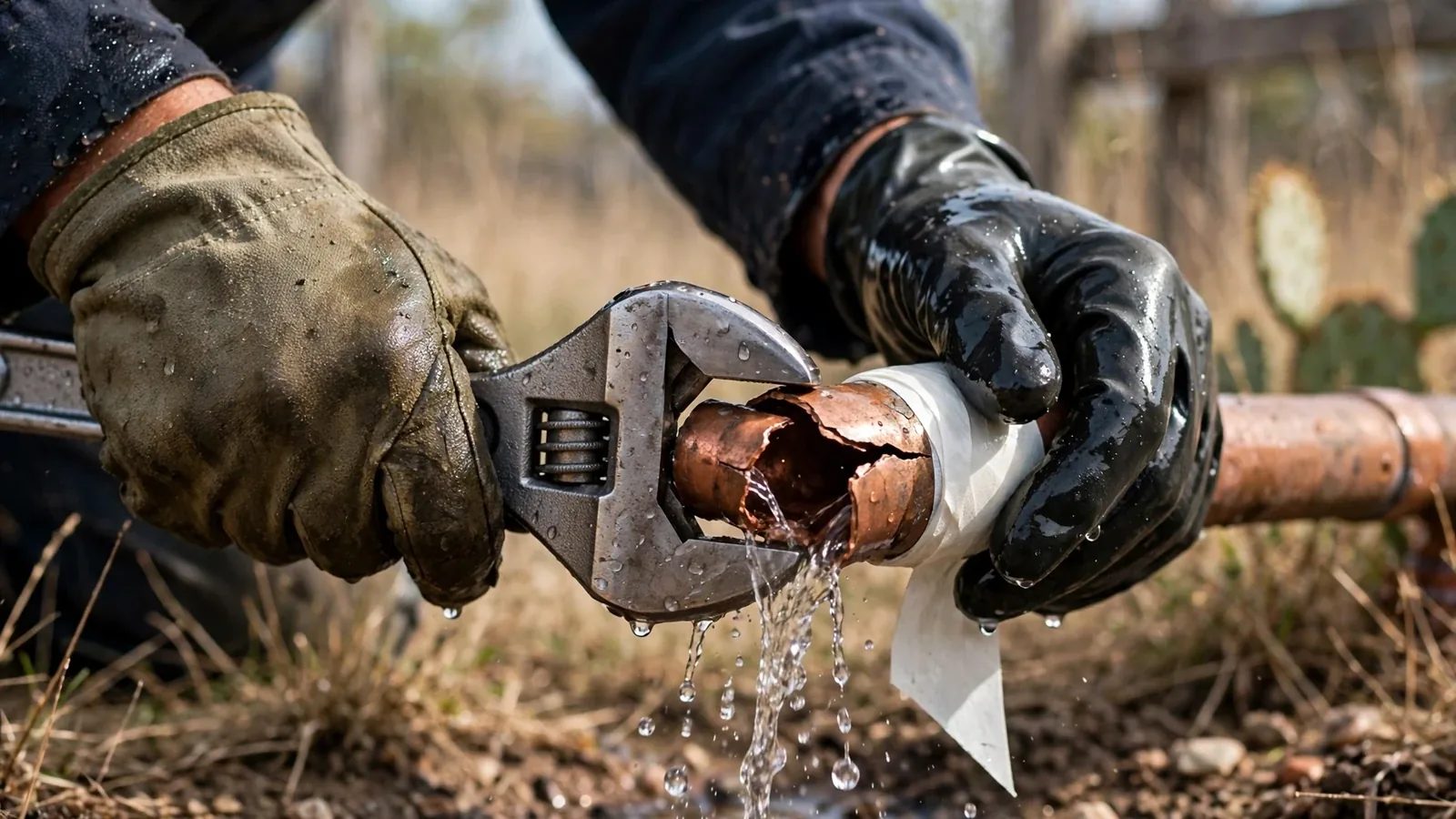
How to thaw a frozen pipe
Open the faucet
Leave it open so melting ice and water can flow out and relieve pressure.
Find the frozen spot
Check pipes along exterior walls, in garages, crawlspaces and attics. A frosted or bulging pipe is the likely spot.
Warm it gently
Use a hair dryer, a heating pad or warm towels. Start at the faucet end and work toward the frozen section.
Check for leaks
When water flows, look for drips along the pipe. A split may show only after the thaw.
What never to do
Avoid these
- Never use an open flame, torch or propane heater on a pipe
- Do not use a kerosene or charcoal heater indoors
- Do not leave a heat source unattended
- Do not hammer or force a frozen valve
- Do not ignore a pipe that bulges or cracks, since it will leak when it thaws
Burst or just frozen
A split pipe leaks when the ice melts. If you see water spraying, a wet ceiling or a stain growing on a wall, close the main shutoff and call a plumber. Open a faucet at the lowest point to drain the line.
Our burst pipe repair page explains what the repair involves, and the 24/7 line takes calls on cold nights.
Prevent itPrevention before the next freeze
- Insulate exposed pipes in garages, crawlspaces and attics
- Disconnect and store garden hoses and shut off outdoor lines
- Open cabinet doors under sinks on exterior walls
- Let a faucet drip on hard-freeze nights
- Seal gaps around pipes where they enter the house
- Keep the heat on if you travel, set to a safe temperature
| Location | Risk | Fix |
|---|---|---|
| Garage | Unheated space, exposed pipes | Insulate, seal gaps |
| Crawlspace | Cold air under the floor | Insulate pipes and vents |
| Exterior wall | Pipe near cold surface | Open cabinet doors, insulate |
| Outdoor bib | Water left in the bib | Disconnect the hose and shut off the indoor valve |
| Attic | Pipes above insulation | Cover pipes with insulation |
What to do if you will be away in winter
An empty house is the riskiest case, since nobody notices a burst until the damage is done. If you leave for several days in cold weather, keep the heat on at a safe temperature, open cabinet doors on exterior walls and ask a neighbor to check the house.
For a long absence, you can close the main shutoff and drain the lines. Ask a plumber how to do it safely for your system, especially if you have a water heater and a fire sprinkler system.
High-risk spotsWhere pipes freeze first
Exterior walls
Pipes against a cold wall with little insulation lose heat fastest.
Unheated garages
A garage can be as cold as the outdoors on a still night.
Crawlspaces
Vents let cold air blow across pipes under the floor.
Outdoor bibs and irrigation backflow devices
Water sits in exposed fittings and freezes first.
A leak after the thaw is common. Walk the house when the pipes warm up and check ceilings, walls and cabinets for water. If you see any, close the main and call us.
Heat tape on a pipe can help in a trouble spot, but follow the maker instructions, since misused tape can start a fire. For calls in nearby Dewey-Humboldt, our 24/7 line is open too.
Codes and standards
Model plumbing codes such as the IPC call for water pipes to be protected from freezing when they run in exterior walls, attics or crawlspaces. Heat tape should be listed by a testing lab such as UL and installed according to the maker instructions.
Prescott Valley and Chino Valley note: how cold it gets
In Prescott Valley, 1991 to 2020 normals show average lows near 25 degrees Fahrenheit in December and about 26 in January. The town sits at about 5,100 feet. Chino Valley is a little lower in elevation but colder, with a mean January low of about 21.5 degrees.
Those are averages. Individual nights are colder, and wind makes pipes on exterior walls freeze sooner. Treat any forecast near or below the low 20s as a freeze night and take the prevention steps above. We serve Chino Valley and Dewey-Humboldt too.
A short winter plumbing checklist
Do these in the fall
- Locate and label the main water shutoff and show everyone in the house
- Disconnect garden hoses and cover or drain outdoor bibs
- Insulate pipes in the garage, crawlspace and attic
- Seal air gaps where pipes enter the house
- Service the heating system so it does not fail on a cold night
- Keep the number of a 24/7 plumber where you can find it
Fifteen minutes in October can save a very bad morning in January. The steps above cost little, and they are the ones plumbers recommend most often.
InsuranceAfter a burst: first steps for your claim
Take photos and video of the burst pipe, the water and every damaged item before you clean up. Keep receipts for emergency repairs and for drying equipment. Call your insurer promptly, since policies set time limits on reporting. Ask what the policy expects you to do to prevent further damage, and keep the old pipe section if the adjuster asks to see it.
Pipe frozen and not flowing?
Call the 24/7 line for help any hour.
If you have had a split once, ask about repiping sections that run through cold areas. For a leak you cannot find after a thaw, leak detection pinpoints it without tearing out walls.
FAQsFrozen pipe questions for Prescott Valley homes
Not on a pipe in a wall. Use gentle heat like a hair dryer. Hot water poured on cold metal can cause cracks.
Look for water at the pipe, a wet ceiling or wall, or a drop in pressure. A pipe may leak only after it thaws.
Moving water is harder to freeze, and a drip relieves pressure if ice forms. It helps but is no guarantee.
Many policies cover sudden water damage from a burst pipe. They may expect reasonable steps to prevent freezing. Read your policy.
Water freezes at 32 degrees Fahrenheit, but pipes in exterior walls and unheated spaces can freeze when the outside air is colder for several hours.