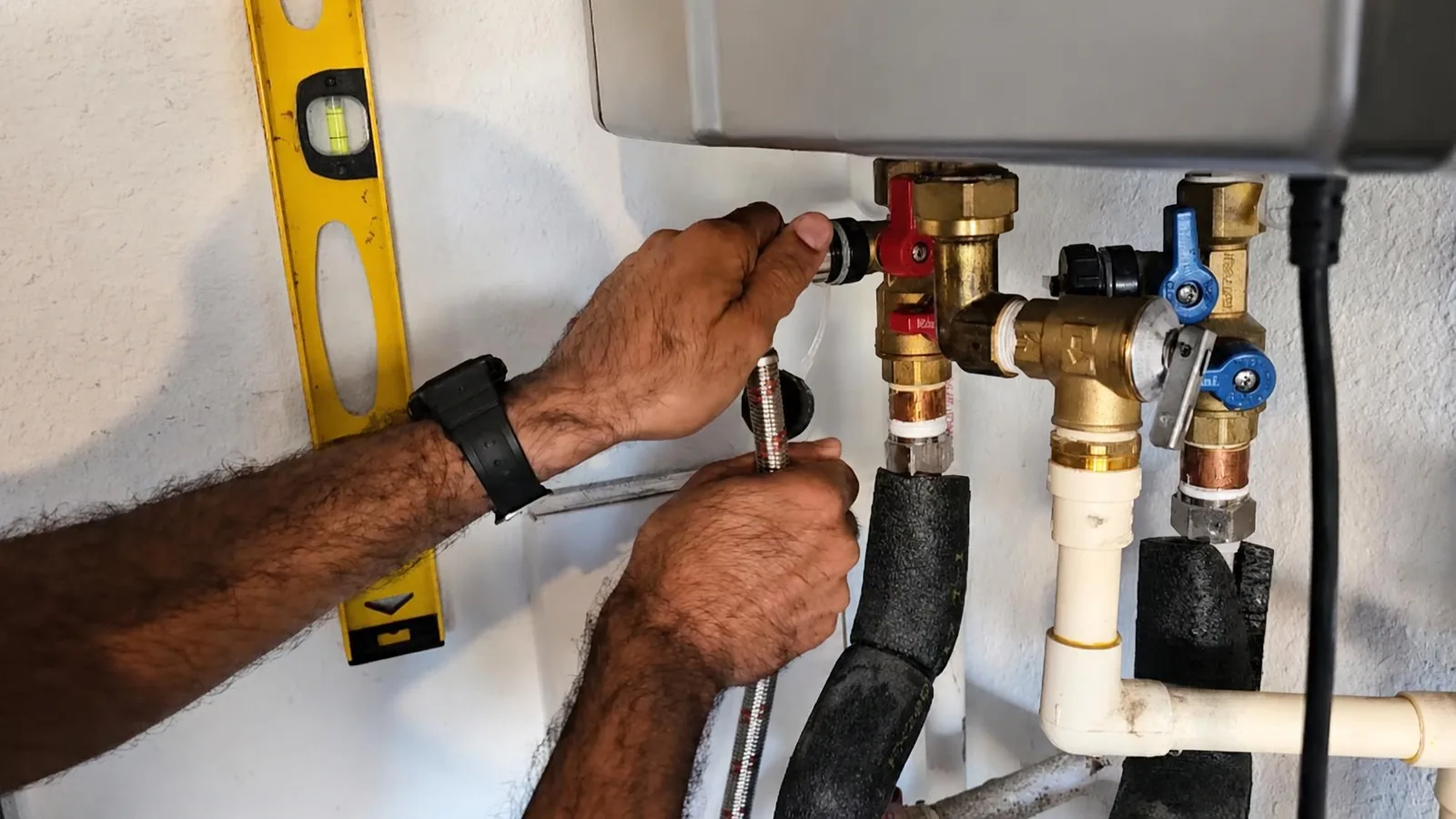
Is tankless right for your house
A tankless heater is rated by how many gallons per minute it can raise by a set temperature. In the cold months, groundwater is colder, so the same heater delivers less hot water than in summer. We size the unit for winter, not July.
Gas units often need a larger gas line than a tank heater did, plus a new vent. Electric units can need a heavy circuit that an older panel may not have. We check both before quoting.
Tank heater
- Lower upfront cost
- Stored hot water can run out
- Takes floor space
- Standby heat loss all day
Tankless heater
- Hot water as long as the flow is within capacity
- Wall-mounted and compact
- No standing tank to fail and flood
- Needs gas line or electrical upgrades, and annual care
Flush and descale service
Mineral scale builds inside the heat exchanger. Left alone, it cuts flow and triggers error codes. A flush circulates a descaling solution through the unit and clears that scale.
Many makers call for a flush about once a year, and homes with harder water may need it more often. Ask your water utility for its annual water quality report, or test your tap, to see how hard your supply is. We flush units whether we installed them or not.
Signs a tankless unit needs attention
- Water that runs warm but never hot at a full flow
- An error code on the display that returns after a reset
- Temperature swings in a steady shower
- Reduced flow at fixtures on the hot side only
- Noise from the unit during heating
Repair and the 110 volt question
Common repairs include replacing a flow sensor, an igniter, a thermistor or a clogged inlet screen. Some small point-of-use units run on a standard 120 volt plug, and they are sized for one sink or a small appliance, not a whole house. Whole-house electric tankless units generally need heavy 240 volt circuits.
We tell you plainly whether a unit you are considering will cover the whole house or only a single tap.
Codes and standards
Gas tankless heaters are listed to ANSI Z21 standards and the installation manual sets the gas line size and the venting. According to most makers, descaling at the interval in the manual is a condition of the warranty, so keep a record of each flush.
Not sure tankless will work for your home?
Call and a plumber will walk through your gas line, panel and household size.
If your current tank is failing, a water heater replacement may be the faster choice. When you want a standard new unit in a new spot, see water heater installation. For a tank that just needs a part, water heater repair is the page to read.
FAQsQuestions about tankless water heater installation in Prescott Valley
Many manufacturers recommend about once a year. Hard water can mean more often. We can check your unit and set a schedule that fits your supply.
Maybe not. Tankless units draw more gas than tanks while firing, so the line often needs to be larger. We measure the run and the meter capacity before quoting.
Generally no. Plug-in units are meant for a single sink or a small point of use. Whole-house electric tankless units need heavy 240 volt circuits.
Scale from hard water and skipped flushing is common. Venting problems and low gas pressure are the other usual causes.
Often a day for a straightforward swap, and longer when the gas line, vent or electrical service needs upgrading. The plumber gives a window after reviewing the setup.